Common land enclosed by a wall to make a park for hunting animals
.

Wall – the enclosure of the common
.

Golden stones in the wall
.
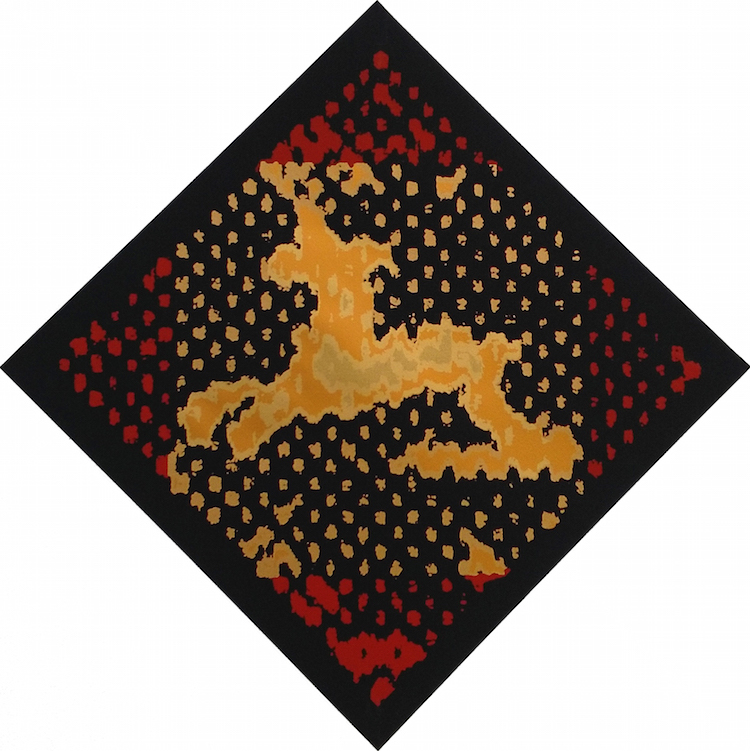
Park Game 1 – hatchment
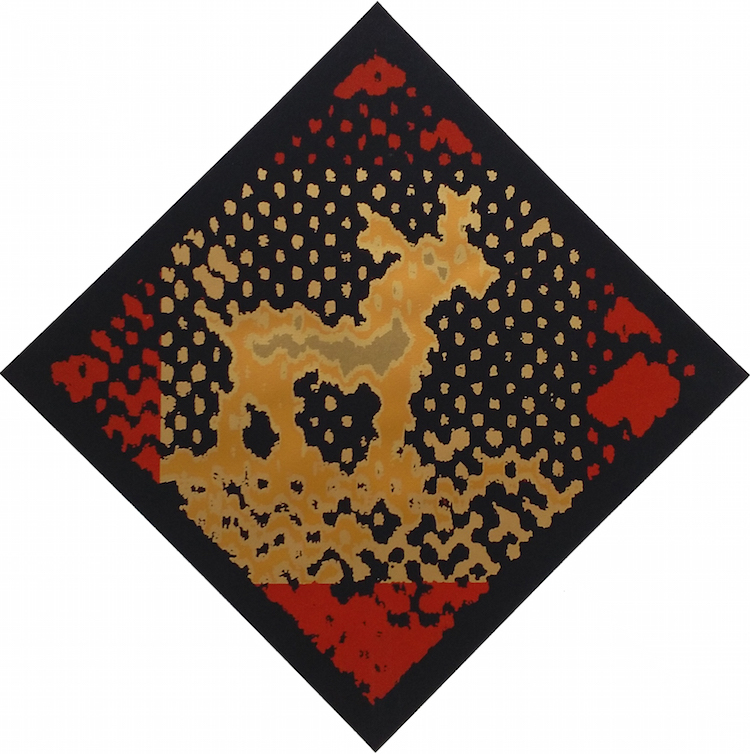
Park Game 2 – hatchment
.

Landshapes – in mud
.
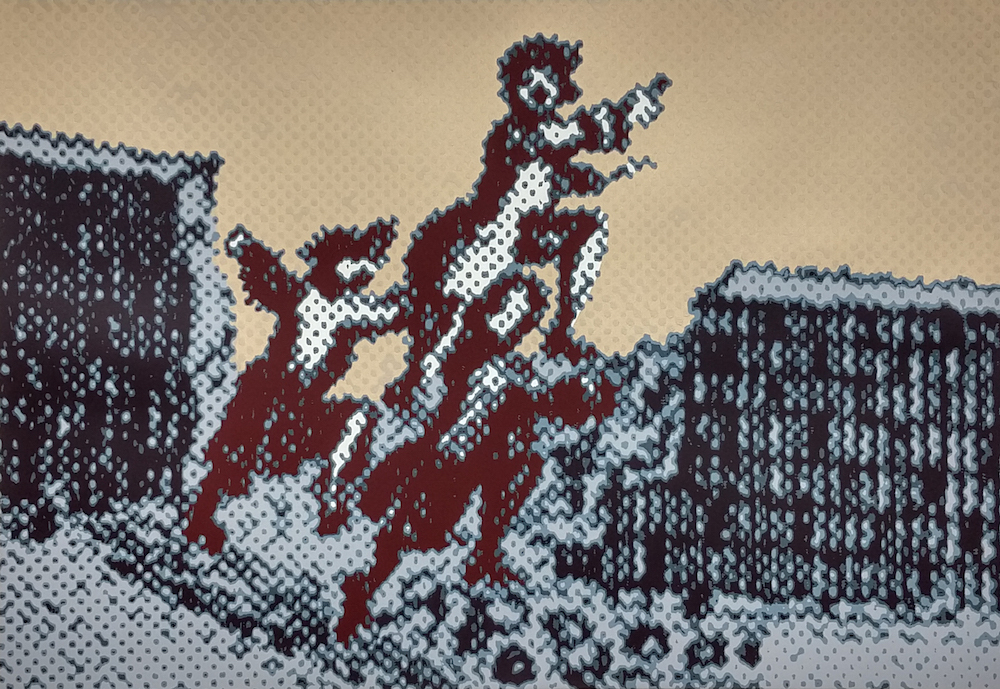
Breakthrough – reclaiming the common
.
This series of screenprints is based on a reproduction of an eighteenth century drawing which shows the vicar of Richmond leading a group of his parishioners to break through the wall into Richmond Park, so that they could complete their annual circuit of the parish. This park was previously common land, but had been enclosed for hunting deer by the aristocracy. The local people were now reclaiming the common.
These prints are the result of a series of reproductions, starting from the original line drawing, then photography, half-tone screening, and black and white off-set litho printing in a book. Then followed digital scanning, digital manipulation, enlargement, and finally screen-printing in colours, including gold ink and mud. The prints expose the distortions of the image which have been created by the multiple modes of reproduction.
Each print shows a detail from the image. Landshapes shows a few of the half-tone dots from the land in the foreground of the image, hugely enlarged, and printed with mud. In Breakthrough the section has been simplified to focus on the main action.
The image is a rare example of a contemporaneous visualisation of one of the many protests which were held against enclosure in England.
I initially found it reproduced in Landscape, Nature and the Body Politic by Kenneth Olwig (2002), and the author kindly sent me a copy. I was particularly interested in the distortions of the image created by conversion of the original line drawing to a half tone reproduction shown in the Olwig book. I have chosen to emphasise these half tone dots and the degradation and deformations that they undergo through great enlargement in my prints. These effects are extreme in the print “Landshapes – in mud”, which shows a few of these deformed half-tone dots from the area of land just in front of the wall.
I have since found the image in several places – in the Hearsum Collection website which shows it in a 1751 book, facing the title page; on a website on the history of Richmond which shows a coloured version; another colour version reproduced in a blog entry form the National Archives; and in the book Whigs and Hunters by EP Thompson (1975) in a version which is not half-tone.
 JOHN ANGUS